
real audiences.
not AI guesswork.
Discover builds audiences from observed human behavior fused with gold-standard consumer research.
We Use AI Too — Differently
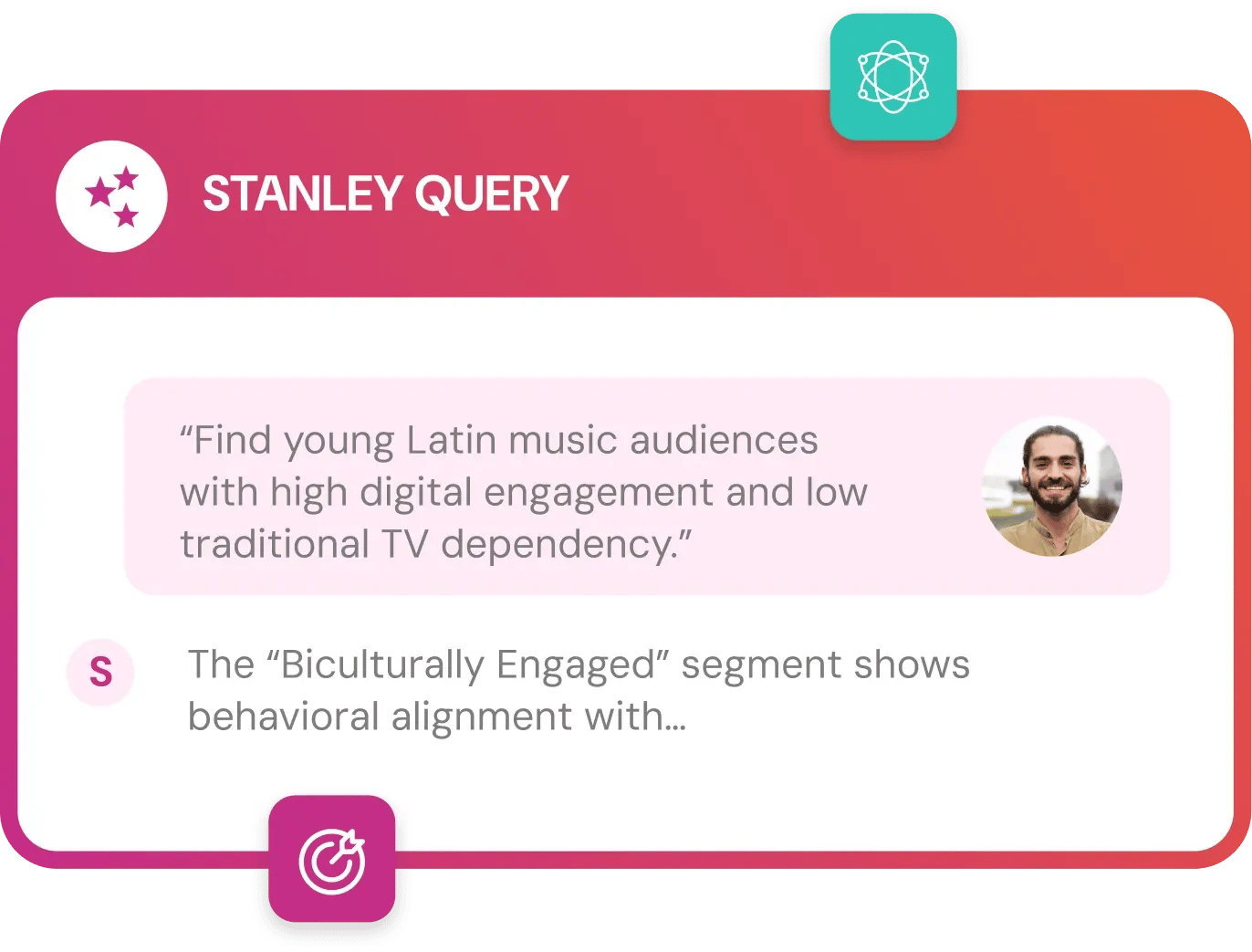
Machine learning powers our segmentation and psychographic modeling. Our AI query builder, Stanley, surfaces audiences and generates strategic profiles in seconds. He’s not hallucinating, he’s querying this legitimate database. The difference: our AI analyzes real behavioral data, normalized to reflect the actual population. No synthetic audiences or assumptions made from publicly available information. AI is the engine, not the source.
What Makes Discover Different
Observed, not inferred
We track what real people search, browse, watch and engage with. Surveys capture the aspirational self. We capture the authentic self.
Data you can’t get from a chatbot
Proprietary behavioral data fused with MRI Simmons, GWI and Kantar — the only direct fusion in the market. Census-weighted across 20+ countries.
Updated weekly
Surveys release every 6–12 months. LLMs freeze at training time. Discover refreshes weekly.
Already Using Research or Social Tools?
If you use MRI Simmons, GWI or Kantar: Discover doesn't replace them, it supercharges them. Surveys tell you they buy Tide. Discover tells you why — they’re sustainably minded parents who follow eco-influencers and engage in parenting communities.
If you use social listening tools: those tools track what people say. Discover tells you who they are, why they act, and where to find them — grounded in census-weighted panel data, not platform-dependent social graphs.
Capabilities
Micro-segmentation
Reveal high-value niche audience groups traditional segmentation misses.
90 psychographic traits
Behaviorally-derived lifestyle profiles — from “Citizen Sleuths” to “Professional Tech Lovers” — that surveys can’t surface.
Influencer identification
Ranked by audience quality and alignment, not follower count.
Data fusion
The only direct fusion of social behavioral data with MRI Simmons, GWI and Kantar.
Conversation monitoring
Track cultural trends in real time. Build audiences from keywords, hashtags and mentions as engagement forms.
AI query builder (Stanley)
Audience recommendations, proxy suggestions and psychographic summaries on demand.
Discover what moves your audience.
Discover
Discover is a proprietary audience intelligence engine that uses social signals, search behavior, browsing data and app usage to identify and understand audiences. Unlike platforms dependent on a single social network, Discover draws from multiple behavioral data sources. It supports audience segmentation, cultural trend detection, influencer identification, competitive benchmarking and persona generation.
Discover's segmentation divides your target audience into interest-based clusters in seconds. Whether you're building a buyer persona or exploring new consumer segments, segmentation surfaces the sub-groups and niche communities that get hidden when you look at a large audience in aggregate. It helps identify white-space opportunities and underserved audiences, and it's especially useful for shaping targeted creative and media placements.
Discover uses k-means clustering analysis to group users who share similar interests (for example: hair care, fast food, crime TV shows). People who engage with the same types of content appear in the same clusters, giving you a clear picture of the distinct communities within any audience.
Psychographics classify people based on their interests, attitudes, habits, values and opinions — not just demographics. Discover uses machine-learning algorithms to estimate 90 unique lifestyle traits, helping you understand your audience's mindset and create more personalized experiences and content.
Each lifestyle trait (like "Party Goer" or "Art Appreciator") is defined by a combination of relevant interests. To score a high affinity, a user needs to meet threshold criteria across those interests. The process works in three steps: first, Discover groups each user's engagement with social pages and posts into interest categories. Second, it measures the proportion of those interest categories for each user. Third, it compares each user's proportion against the average U.S. adult population.
Discover's demographic sample is representative of the American population aged 18–69, covering age, gender and location.
Yes — Discover lets you compare up to three different audience targets in the same search. You can compare brands, influencers, TV show audiences or lifestyle segments side by side to see what makes them similar and different. This is useful for competitive analysis, category benchmarking, and evaluating how influencers or brand partners align with your audience.
These are the key metrics Discover uses to report audience interest. Affinity measures how distinctively an audience over-indexes on a particular interest compared to the general population. Reach measures how many people in an audience engage with a topic. Penetration measures what percentage of an audience engages with it. Agencies, brands and media companies use these metrics to understand what's unique about their audiences and make strategic marketing decisions.